Skip to content

Mauro Munzi


Digital technology has a price, and the people who buy it are not the only ones who pay; it is paid by the workers who keep the machines running, by the annotators paid by the microtask at the edges of the world, by knowledge workers quietly stripped of their intellectual property. And all of us pay in the water that cools the data centres and in the land they take up.

Who I am

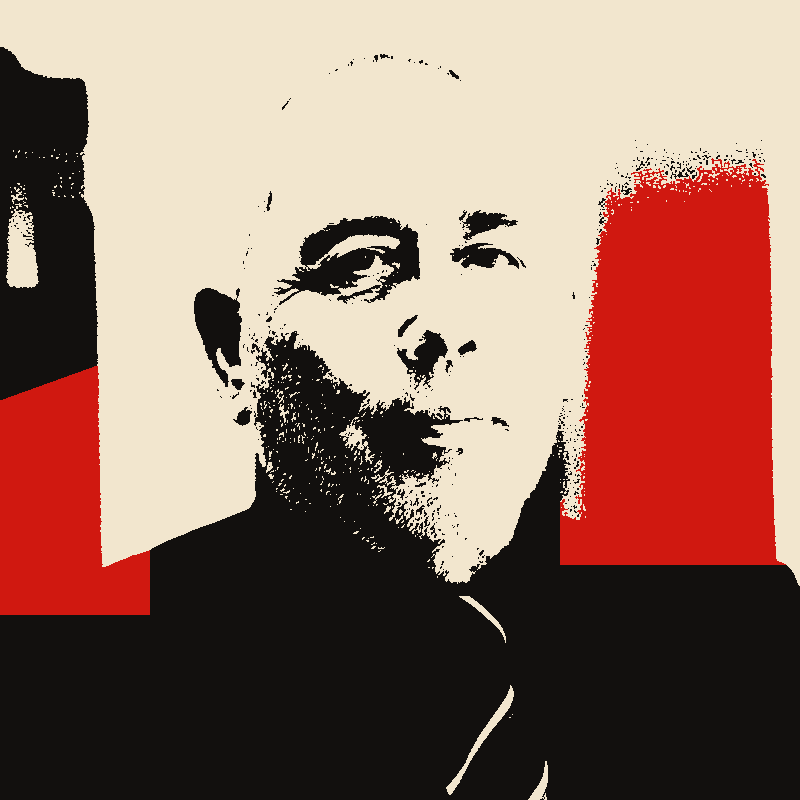
Portrait of Mauro Munzi, reduced to two inks with a red field on the wall behind him.
Mauro Munzi

I read philosophy at Sapienza University of Rome, working under Lucio Colletti on Marx's formula for the transformation of values into prices. I then spent more than forty years inside the ICT industry: Olivetti, Digital, IBM. At Sapienza I taught computer science as a contract lecturer.

Two worlds, and two halves of the same trade: together they account for the way I write. I read European regulation the way it is read by people who have had to apply it, not by people who comment on it, and I describe the dynamics of the technology market from the inside, because I was one of its actors. Of the new ideologies of AI I trace the roots, and try to make out the consequences.

I now work on digital sustainability with Sloweb, where I am an activist: for a digital world that is sober, clean and fair. Everything I write comes out of that perimeter.

Where to read what

This site says what is inside the books, what I have published elsewhere, and how I work. It is the record of where the ideas are kept and how the results advance.

But this is a site for reference and synthesis, and the life of the work goes on elsewhere. Every second Saturday Chi paga il digitale (Who Pays for Digital) comes out on Substack: a letter on labour, power, ideology and energy. One piece at a time, one subject at a time, with the source given in full. Subscription is free. The letter is written in Italian, and so is the archive.

If you want to write to me

At posta@mauromunzi.it. There is no contact form: an address is enough, and I am not going to ask you for details I do not need and do not trade in. Write in English or in Italian, whichever you prefer.

I am on LinkedIn, where a post comes out twice a week drawing the argument out of what I am writing elsewhere; and on Substack with Chi paga il digitale, which is the letter. Where the full texts appear is set out at the foot of Writings.

Books

This page sells nothing. It says what is inside the books and who they are for. Where to buy them is at the foot of the page, when there is something to buy. Both books are written in Italian.

Per un digitale sobrio, pulito e giusto

For a Sober, Clean and Fair Digital World · A critical route to the autonomy of the firm

FrancoAngeli · late November 2026 · in Italian

Draft cover: red wedge and black shapes on ivory paper, with the title in slanted red letters.
Draft cover

The book starts from a question that people who run an organisation rarely put to themselves in these terms: what are you still master of. The digital services that hold an organisation together are almost all in someone else's hands, and the dependency does not come from a decision taken once. It comes from a sum of small choices that nobody recorded as strategic: a data format, a contract renewed out of inertia, a supplier who ends up being the only one who knows where things are.

From there the argument divides into two genealogies. The first reconstructs digital sustainability as a contradiction, from the paradox of dematerialisation through to the three seasons that produced it: energy efficiency and waste between 1990 and 2005, the irruption of cloud and platforms up to 2015, and then artificial intelligence inside the climate crisis. The second reconstructs the relation between practice and rule, and shows how a voluntary good practice becomes first a standard and then an obligation, together with the tensions that movement leaves unresolved, beginning with the question of who actually writes the rules.

The closing part is operational, and not in the sense of a list of tips. It takes the instruments a firm already has in the house, the risk register, the code of ethics, the sustainability report, the bodies that deliberate, and shows how digital sustainability grafts onto them without building a second apparatus alongside the first. With real Italian cases of corporate digital responsibility, from Enel to CSI Piemonte, from Seeweb to Piano D and Smart Flow.

  1. Foreword by Pietro Jarre Why we have a choice

    The new gatekeepers, the language of marketing as a form of command, the data pumps, and the firm that discovers it has become a vassal.

  2. Genealogy The contradiction

    Invisible labour, concentration of power, the materiality of digital technology, and Italy's lag measured against Europe.

  3. Genealogy Practice and rule

    How the voluntary becomes binding, what it costs small firms, and who wrote the rules they will have to apply.

  4. Practice The code of ethics

    Three horizons and five stages for grafting commitments onto the governance instruments a firm already has.

The volume closes with three appendices that can be used on their own: a reasoned guide to the rules, from the CSRD to the AI Act by way of ecodesign, electronic waste and the ISO standards; a reasoned bibliography of digital sustainability that includes the sceptics as counterpoint; and a glossary of tools and acronyms, with a review of several measurement algorithms currently on the market.
Cover and price are the publisher's decision, and at the date of this page they have not arrived. This entry will be updated as soon as they do.

Le Ricette di Sloweb

The Sloweb Recipes

EDT · March 2027 · in Italian

The first book says how things stand. This one tries to say what is actually done, in practice, to exercise digital sobriety: one recipe at a time, with the ingredients, the time it takes and what you get out of it. Real recipes, in the sense that they can be carried out, recounted, recommended.

It is for ordinary people, and for anyone with an organisation to run and no technical department to delegate to: small firms, associations, schools, the offices of small public administrations. It comes out of Sloweb, the association in which this work of sowing digital awareness has been going on for years.

Publisher
EDT
Publication
March 2027
Contents
fourteen individual recipes and two framing ones
Status
under revision, expansion requested by the publisher

In progress

Manuscripts · no publisher

Four texts in progress which as of today have no publisher. They are here because a page about books that showed only the ones under contract would account for half the work; and because a manuscript without a contract is a different thing from a forthcoming book, and that should be stated plainly rather than left to be inferred, not least for readers who do not know that writing a book is not even halfway through the labour of publishing one.

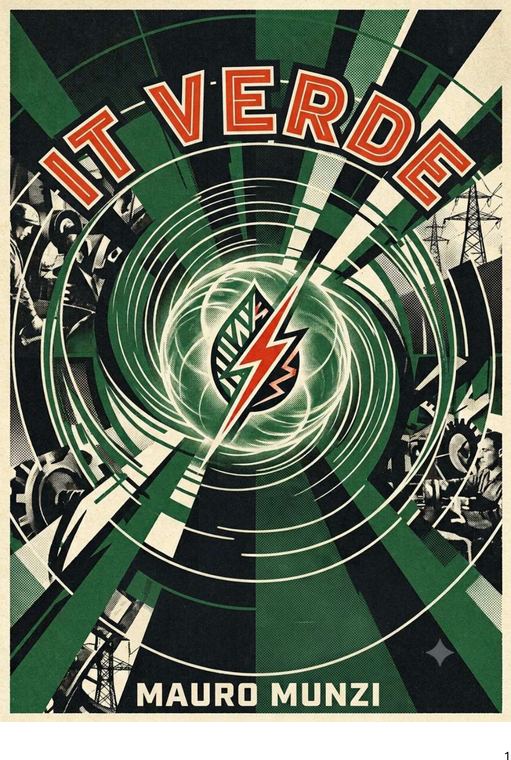
Cover of IT Verde: a constructivist poster with green rays and an orange lightning bolt at the centre.
Working cover

IT Verde

Green IT · An operational handbook of digital sustainability

One hundred and thirty-eight pages, finished. It is not an essay: it is a handbook, and it is meant to be used. It is written for the people who decide, that is chief executives, heads of information systems, finance directors, senior public officials, and it presupposes no particular environmental sensibility; it presupposes that you have an interest in managing your organisation's resources well.

It is read in modules, according to the maturity of whoever opens it. Ten actions of high impact and low complexity, verifiable within a few weeks, to begin with. Then the governance framework, with indicators and change management. Then twenty-six operational initiatives divided by area and by level of investment, from server consolidation to cooling, from efficient code to the optimisation of programming interfaces, each with its payback period. Then compliance, which is the section to keep open in front of an auditor. And at the end a review of more than fifty measurement programmes, with the criteria for choosing among them. A set of downloadable tools, spreadsheets and checklists is planned.

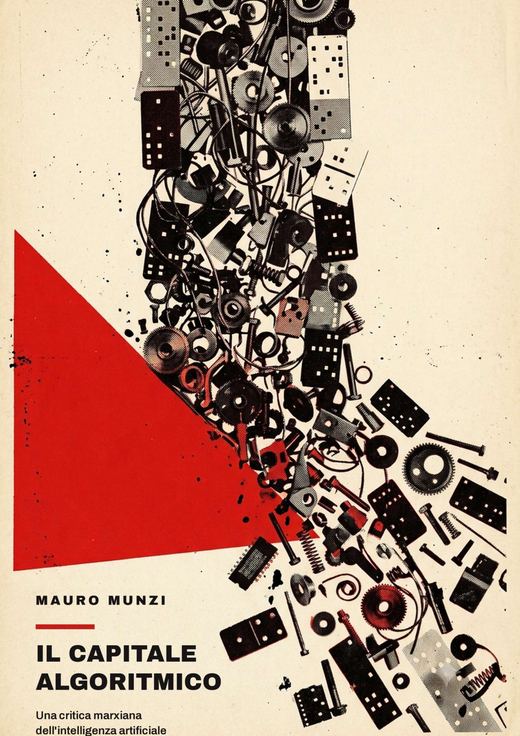
Cover of Il capitale algoritmico: red wedge and a photomontage of gears on ivory paper.
Working cover

Il capitale algoritmico

Algorithmic Capital · A Marxian critique of artificial intelligence

Manuscript closed, with readers. It reads artificial intelligence with the instruments of the critique of political economy: the general intellect expropriated, the price-form that stops informing and starts commanding, the cognitive machine as the embodiment of a social relation. It is the theoretical text from which nearly all the others descend, and it presumes to rewrite the theory of value in the light of the algorithmic machine.

Un fiorino!

One Florin! · How big tech collects on what other people produce

On the incomes large technology firms collect by virtue of position rather than of what they produce. A single criterion generates four species of tollgate: those who charge for passage, those who stage the encounter between supply and demand, those who hold a condition no one else can reproduce, and those who appropriate the result of work done elsewhere. The method is to concede that the service is rendered, and to separate it from the toll.

Il demiurgo incorporeo

The Bodiless Demiurge

The creed of the computing industry treated as a document. A table of correspondences between the gnostic figures and the materialist categories carries a text in liturgical register, article by article, with Andreessen and Thiel as named adversaries. The thesis the materials will support: the churches of artificial intelligence have no faithful, the real congregations are elsewhere and have rents and balance sheets, and the proselytism that counts runs through money. The faithful already exist: they are the firms and the individuals held fast by lock-in.

Where to find them

In bookshops and online stores from the day of publication, and through the channels of the respective publishers. Nothing is sold from this page and no e-commerce link starts here.

Writings

For each piece you will find where it appeared, when, and what it argues. Not a summary: the argument, in three lines, so that you can decide whether it is worth your time before opening it. Unless the title is given in English, the piece is in Italian; the English rendering of the title is there to say what it is about.

Journal essays

Critica Marxista

Gramsci, il senso comune e l'Intelligenza Artificiale. Ipotesi per una diversa egemonia

Gramsci, common sense and artificial intelligence. Hypotheses for a different hegemony · Third series, 2/2026, p. 87 · section “Problemi dell'Intelligenza Artificiale”

The American right has built a Gramscianism of its own, and it did so by stripping Gramsci of his class foundation. From there the essay shows the ambivalence of “common sense” and the instrumental use made of it: the left does not produce cultural interventions at the scale and speed at which hegemony now operates, and generative artificial intelligence opens a room for manoeuvre on this front that did not exist before.

Il general intellect al tempo della intelligenza artificiale

The general intellect in the age of artificial intelligence · New series, 5-6/2025, September-December, p. 106 · section “Laboratorio culturale”

Has the general intellect really constituted itself as collective and antagonistic knowledge, and in the dialectic between capital and the working class, whose side is it on? The question forces one's hands into the central nexus of modernity, the one between science, technology and the social relations of production, from Taylor's day to the age of artificial intelligence.

Critica Marxista is a quarterly: issues are available by subscription and in university libraries.

L'IA possiede anche i luoghi della democrazia?

Does AI own the places of democracy too? · On the ownership of the means of deliberation

Against the muscular metaphor of the DemocracyNext report, which treats democracy as a faculty that atrophies if it goes unexercised. That figure shifts the problem onto the capacities of citizens and the pedagogy of procedures, and leaves in shadow the question of who owns the means by which deliberation happens. The crisis of representation does not come from civic atrophy: it comes from the material displacement of the places where decisions are taken, into treaties, independent authorities, budget constraints, proprietary infrastructures and terms of service. In place of the distinction between complementary and competitive artefacts I propose the criterion of reversibility.

La riappropriazione del senso comune come ipotesi per una diversa egemonia

The reappropriation of common sense as a hypothesis for a different hegemony · A Gramscian analysis of common sense in the age of Trump

The extended version of the essay published in Critica Marxista. Gramsci as the key to the contemporary battle over common sense, a terrain the right has occupied by severing hegemony from its class foundation; and an attempt to reverse that appropriation with Debord, with détournement and with generative artificial intelligence as instruments of cultural intervention. A different hegemony can only come from the passage from common sense to good sense, and from symbolic production to political organisation.

L'intelligenza artificiale morirà di fame?

Will artificial intelligence starve? · The more efficient it becomes, the more it devours what feeds it

Jevons's paradox, formulated in 1865 on coal, applied to data. Efficiency does not reduce the consumption of raw material, it expands it; and human data, unlike coal, is a historically determined resource. When the original seam falls below the threshold, models move to synthetic data and model collapse begins. Kate Crawford calls it autophagy, and the term is clinical, not metaphorical.

Non esistono modelli neutri

There are no neutral models · On the corpus and on what it gives back

A language model does not think: it compresses a corpus and gives it back in probabilistic form. It follows that partiality is not a defect to be corrected downstream with a filter, but a property of what was fed to the machine.

Articles

Volerelaluna

L'intelligenza artificiale morirà di fame

Artificial intelligence will starve · 29 May 2026 · Controcanto column

The version of the autophagy argument written for a wider readership, with a passage at the end that does not appear elsewhere: Jevons's paradox applied to data is the contemporary translation of the tendency of the rate of profit to fall, because capital, in order to sustain its own algorithmic surplus value, consumes the cognitive conditions that make the production of value possible.

Under review

Essays in English · submitted

Two essays in English are with the editors of two different journals, one British and one American, which are the natural venues for this kind of thought in those quarters: they are in peer review and there is no outcome yet.

The Value-Form in Digital Capitalism and the Horizon of Its Supersession

International journal · under peer review

Five waves of criticism have tried to bury the Marxian theory of value, from Böhm-Bawerk in 1896 to the post-operaist and digital versions of recent years, and none has put in its place an instrument that explained as well what Marxism had set out to explain. The essay restores the Marxian names to the present through three categorial substitutions: algorithmic fixed capital, platform rent, and the openness of cognitive infrastructure as a parameter of reappropriation at the level of the species. By grafting Kalecki's degree of monopoly onto Marxian theory, it reverses the redundancy theorem of Sraffa and Steedman: under algorithmic monopoly it is price that is mute without value.

The Commodity Denied. Against Varoufakis's Technofeudal Hypothesis

International journal · submitted August 2026

Against the technofeudalism hypothesis, taken up by Varoufakis and by now common sense on the left as well. Three fronts: the fetish of the denied commodity, the circularity of the category of unproductive capital, and the semantic surrender of those who call feudal what the theory of value describes better as the typical behaviour of capital brought up to date by the algorithm. The feudal vocabulary supplies a name; the value-form supplies the measure by which the phenomenon can be understood.

Where to find me

  • Critica Marxista

    A journal of political and cultural reflection, third series, Futura Editrice. Issues are available by subscription and in university libraries.

  • Stultifera Navis

    A transdisciplinary space for sharing knowledge. My author page collects the four essays, readable in full and without registration.

  • Volerelaluna

    A journal of political and cultural intervention. The piece on the autophagy of data appeared in the Controcanto column.

  • Chi paga il digitale

    The letter, on Substack, every second Saturday, in Italian. Labour, power, ideology, energy. Subscription is free and the archive is open to those who do not subscribe.

  • Sloweb

    The non-profit association in which this work has been going on for years. Its site carries the blog, the events and the collective documents.

From 13 October 2026 my long texts no longer appear as LinkedIn articles. They go into the letter, Chi paga il digitale on Substack, which has room for the apparatus: figures with their source, perimeter and year, and primary documents quoted in full. What stays on the feed is the post that draws out the argument, and the archive of the letter is open to non-subscribers as well.

Where I write from

Artificial intelligence is not one technological sector among others: it is the ground on which all the contradictions of the capitalist mode of production, and of the social relations that mode expresses, are played out. That is why it is today the most advanced front of its own supersession, and why it is my first object of study.

The object

Digital technologies do not have “an impact” on social relations: they change the ways in which capital extracts surplus value and builds rents for itself, and in changing them they bring into the open what used to stay implicit: the working day that does not end with the shift, collective knowledge crystallised in the machine and sold back to us, the price that stops informing and starts commanding. These are old determinations that computing infrastructure makes legible to the naked eye. Anyone who wants to understand how the law of value works today need not go looking for it in the nineteenth century; it is there in what a large language model charges for use.

Hence the choice of ground. I do not study artificial intelligence because it is new. I study it because it is where the contradiction can be seen most clearly.

The roots

I cut my teeth on a formula. At Sapienza, under Lucio Colletti, I worked on Marx's formula for the transformation of values into prices: the passage where it is decided whether the law of value survives its confrontation with actual prices, or remains a philosophical premise with no purchase on the real. A formula is the place where a theory holds or breaks, and having had my hands in one as a young man I no longer argue about capitalism by way of invective or fetishes.

The thread running through everything I write is contradiction. The mode of production does not accompany social relations: it determines them, and it determines them by producing within itself the conditions that negate it. This is why readings in which technology is good or bad depending on its use hold no interest for me: that figure stages a neutrality which does not exist, and shifts the question from relations of property to the intentions of whoever presses the button.

The interlocutors are these: Marx for the value-form and for the Fragment on Machines; Gramsci for common sense and hegemony; Guy Debord for détournement (the practice of turning an adversary's own materials against him). They are not authorities only, they are instruments: they serve to give an objective form to what is happening.

The craft

I designed systems before I criticised them. Forty years and more inside the ICT industry, at Olivetti, at Digital, at IBM, and contract teaching at Sapienza; enough to know that a system is not the technical translation of a neutral requirement, but the place where somebody decided on everyone's behalf that the requirement was neutral, “natural”, rather than the bearer of interests, his own. Every system embeds decisions, and decisions hide where nobody goes looking for them: in default values, in data formats, in alarm thresholds, in what the event log keeps and in what it throws away.

The same holds for regulation. I read a European regulation the way it is read by someone who has had to apply it, not by someone who comments on it: looking at what it obliges you to rebuild and what can be satisfied with one line of interface, when the obligation actually bites, and which authority has the power to sanction it. That is the difference between a newspaper headline and an entire project to be done again.

Ideologies, and the point where they turn into theologies

The computing industry does not confine itself to selling products: it produces a creed, and produces it loudly and plainly, as a profession of faith: progress as a moral duty, limitless acceleration as an obligation, the market as the only possible orderer of the future, and at bottom the promise of an intelligence that surpasses us and would therefore deserve to decide in our place. When an ideology stops arguing and starts professing, it has changed genre: it is no longer political economy but theology.

Of that creed I trace the roots and analyse the consequences. I take the manifestos literally, because the text of a profession of faith is a document like any other; and I ask those who sign it the one thing a faith cannot supply, namely what happens to the people who bear the consequences.

How I verify

From all this a discipline follows, and a method: a critique of the algorithmic mode of production that gets its figures wrong hands the adversary the one reply he needs in order to discredit the whole case.

Figures

Every figure carries its source, its perimeter and its year. The perimeter is the part that is almost always missing and it is the part that decides: saying how much energy a data centre consumes means little unless you say whether the count includes cooling, construction, and the terminals of the people connecting to it. When the perimeter excludes something material, I say so; when two reliable sources diverge, I give both and say why they diverge, rather than picking the one that suits me.

Regulation

I read it in the original text, not in the commentaries. A consultant's commentary tells you what it suits him for the rule to say, and in regulations hundreds of pages long the distance between the article and its summary is where the battle is won or lost. Of every rule I also say what it does not say: an obligation that bites in two years is not an obligation today, and an obligation without a sanction is not the same thing as an obligation with one.

Documents and quotation

Quotation marks go only around a string verified against the primary source. When what I report comes from a journalistic reconstruction and not from a document, I say so inside the text and not in a footnote.

When a source does not hold

The piece does not run. It does not run in a softened version, it does not run with a “reportedly”, and it does not run with the source replaced by another one that says the same thing without holding any better.

When I get it wrong

When an error comes to light I correct it in the text and record at the foot what was there before, with the date. If you are the one who finds the error, write to me at posta@mauromunzi.it; this goes for the books too.

What I do not do

  • I do not use the techniques of the attention economy, which are the object of my critique.
  • I do not send automated messages and I do not use tools that send them for me.
  • I put no trackers and no cookies on these pages, and I load nothing from other sites.
  • I carry no advertising and I accept no payment for writing about a product.